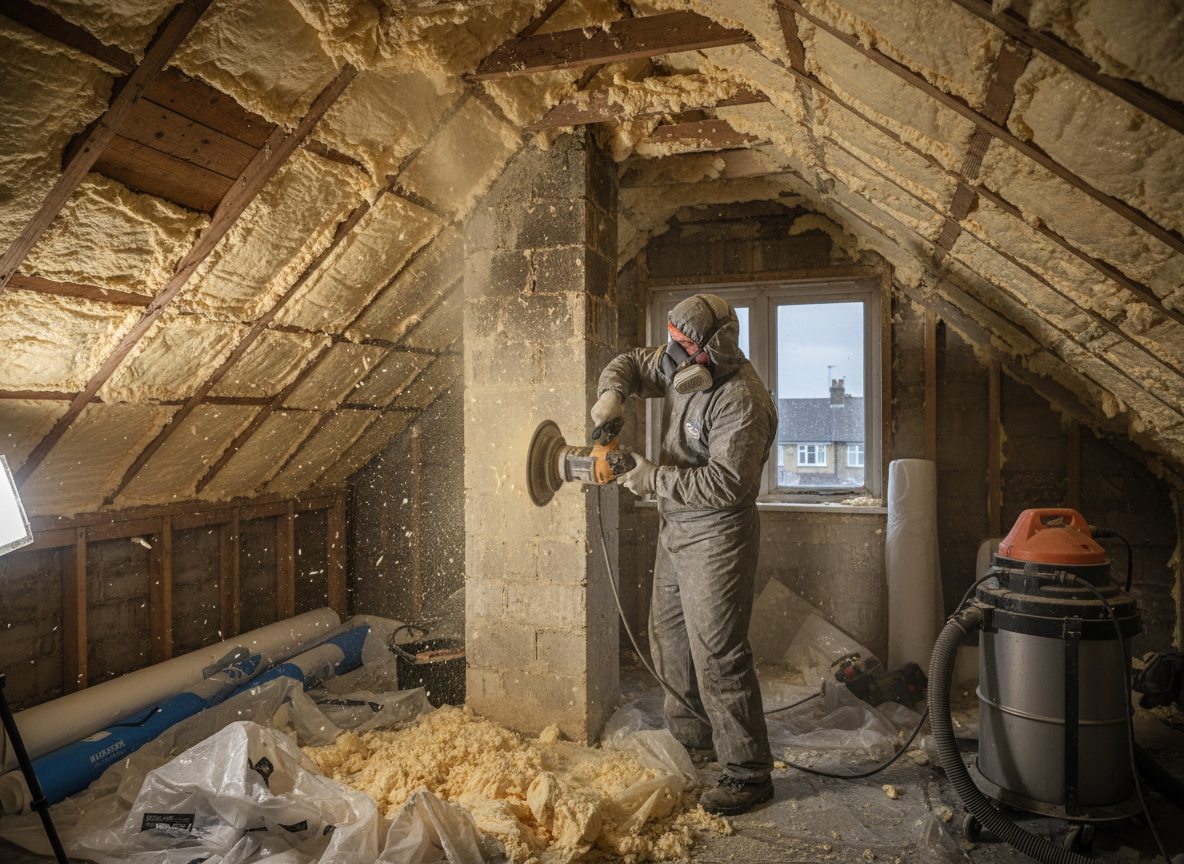
Closed cell spray foam bonds tightly to timber joists, plaster and brickwork in Croydon's older terraces and semis. Removing it requires cutting back to sound substrate without damaging original lath and plaster or roof timbers, especially in homes built before 1930 where ventilation paths are limited. Moisture trapped behind the foam often leads to rot in rafters along south-facing slopes that receive the heaviest rainfall in the Croydon area.
Extraction crews working from Junction Road must account for narrow access hatches common in CR2 postcodes and the extra weight of saturated foam after winter storms. Dust and debris containment is essential to protect remaining insulation and electrics. Disposal follows local waste rules for expanded polyurethane, which cannot go into standard skips used for general building waste in Surrey.
Homeowners sometimes attempt DIY removal using scrapers or solvents, which releases isocyanates and leaves residue that prevents new insulation from adhering. Professional teams use negative-air machines and sealed chutes to move material straight into covered vehicles, avoiding contamination of gardens or neighbouring properties in dense Croydon streets.
After removal, lofts are inspected for timber condition and ventilation upgrades before any replacement insulation is considered. Properties near the Brighton Road corridor often need extra attention to ridge vents that were blocked during the original foam installation.
Technician insight
In Croydon, the thing that catches most people out with closed cell spray foam removal is how the foam fills every gap between original ceiling joists in pre-war terraces along Junction Road and nearby streets. Once winter rain soaks through the tiles, the foam holds moisture against the timber for years, and any attempt to pull it off in large sheets tears the laths. You have to work in small sections with constant moisture checks or the joists start to crumble before you finish.
South Croydon Loft Clearance
Homeowner in a 1920s terrace near Purley noticed damp patches after heavy autumn rain. Inspection found closed cell foam completely filling the eaves and trapping condensation against rafters. Crew removed the foam in controlled sections, dried the timber and cleared blocked ridge vents. Loft now ventilates properly with no further moisture issues.
How it works
- 1
Site Assessment
Inspect loft or wall cavities, note access points and check for hidden moisture or rot in Croydon properties.
- 2
Containment Setup
Install dust barriers and negative-air equipment to protect living spaces and neighbouring homes.
- 3
Foam Extraction
Cut and remove closed cell material in sections, bagging it for compliant disposal.
- 4
Substrate Cleaning
Scrape residue from joists and brickwork, then vacuum all surfaces.
- 5
Final Inspection
Check ventilation paths and timber condition before handover.
Pricing
Upfront quotes after inspection; price depends on foam thickness, access difficulty and volume removed.