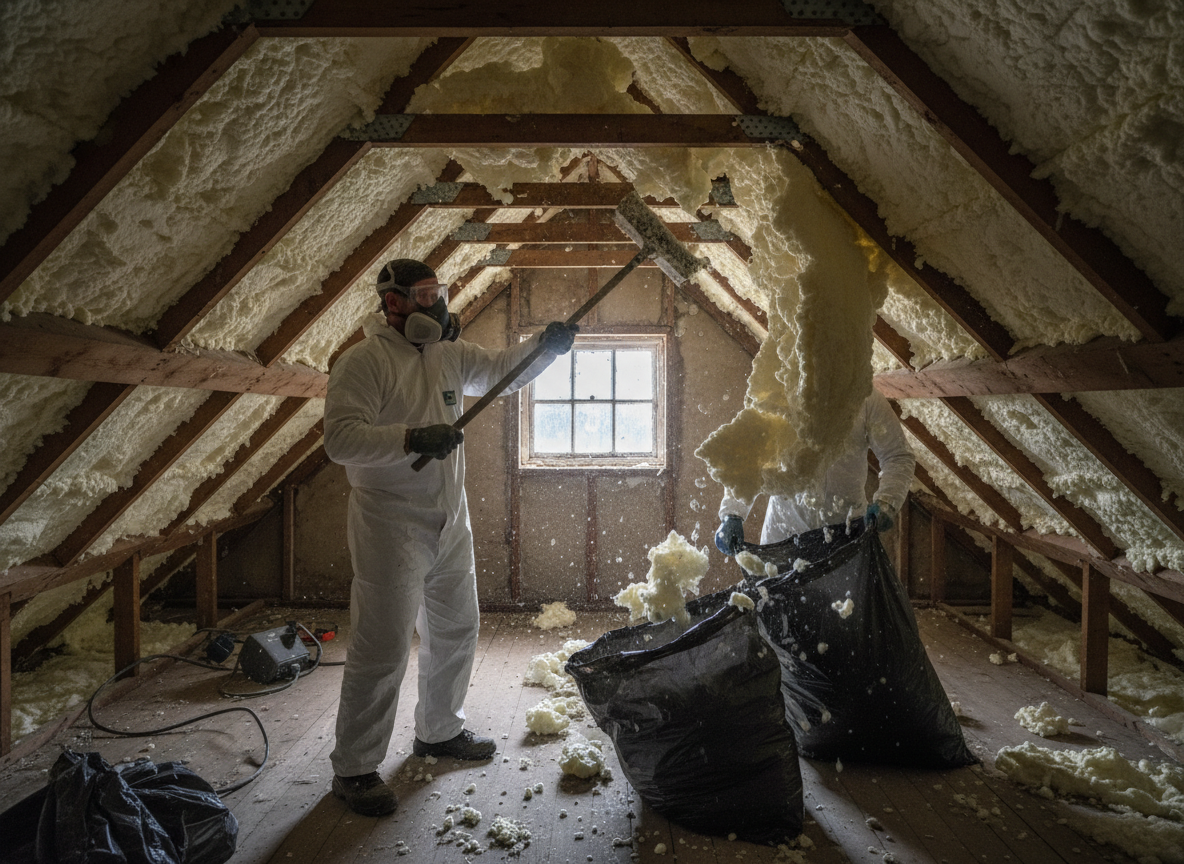
Open cell spray foam was widely installed in Croydon lofts during the 2000s and early 2010s, especially in Victorian terraces along roads like Addiscombe and South Norwood. Unlike closed cell, the open structure absorbs water readily. Once a roof leak or poor ventilation allows moisture in, the foam stays damp, encouraging timber decay in rafters and ceilings common to these pre-1930 properties.
Removal starts with careful cutting and vacuum extraction to avoid disturbing original lath and plaster ceilings below. In Croydon’s mild, wet winters, crews often find hidden condensation trails running along party walls in semis. The work must finish with full debris clearance and ventilation checks, because any residue left behind can re-absorb rain blown under tiles during the area’s frequent autumn storms.
Homeowners in CR2 and CR0 postcodes frequently discover the issue only after noticing musty smells or sagging insulation in upstairs rooms. Because many of these houses have limited loft access and shared chimney stacks, extraction requires sectional removal rather than wholesale stripping. Proper disposal at licensed local sites is essential, as the foam cannot be left in domestic waste.
After extraction, the loft is left ready for traditional mineral wool or sheep’s wool replacement. This approach suits the solid-wall construction and variable roof pitches found throughout Croydon, where breathability matters more than airtight sealing.
Technician insight
In Croydon the thing that catches most people out with open cell spray foam removal is how quickly the material soaks up water from the frequent driving rain that hits south-facing roofs on Victorian terraces. Homeowners assume the foam is dry because the ceiling looks fine, yet once we open the loft we find saturated layers along the eaves that have already started softening the rafters.
South Norwood Terrace Loft
Open cell foam installed ten years earlier had trapped rainwater from a slipped tile. We found damp rafters and mould along the party wall. Sectional extraction and debris removal took two days, after which the loft dried out and was ready for new insulation.
How it works
- 1
Site Inspection
Assess loft access, foam depth, and any timber damage in Croydon properties.
- 2
Containment Setup
Protect ceilings and electrics before cutting begins.
- 3
Foam Extraction
Sectional removal and vacuum collection of open cell material.
- 4
Debris Clearance
Full removal of residue and disposal at approved Greater London facilities.
- 5
Ventilation Check
Confirm airflow to prevent future moisture issues.
Pricing
Upfront quotes after inspection; cost driven by loft size, foam depth, and access constraints in older Croydon stock.